Rent vs. Buy in San Diego, CA

You've probably heard that renting is throwing money away, and that buying is always the smarter move. It's the most repeated advice in real estate, and it gets a lot of people in trouble.
In San Diego, buying isn't always smarter. The math can land on either side, and which side comes down to numbers specific to you: how long you'll actually stay, how much of your down payment and monthly savings you'd really invest instead of spend, and whether the house you want sits in a neighborhood with opportunity to appreciate. Those are questions you can actually answer, and once you do, the decision stops feeling like a leap of faith. Here's how to run the numbers, and where the trap doors are.
Start with a fair comparison
Pick a single home type and compare it to itself. That sounds obvious but a lot of people don't do it.
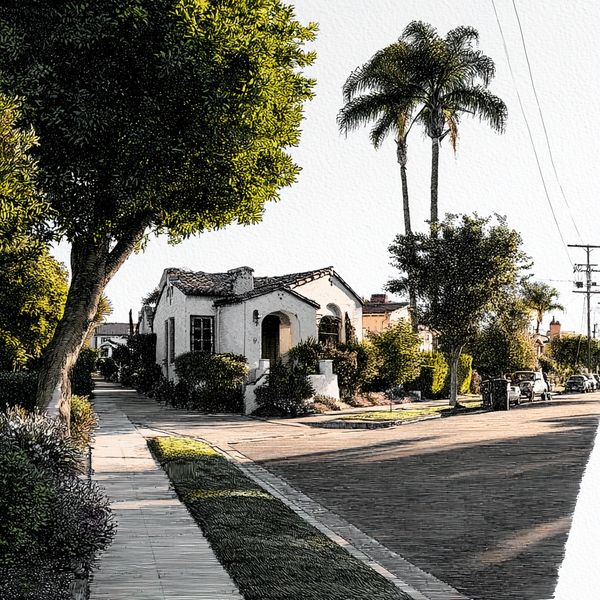
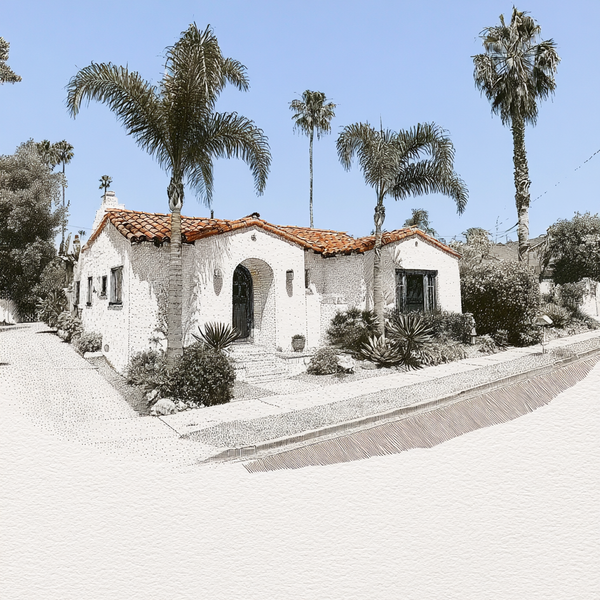
Take a detached single-family house in North Park. As of June 2026, that house rents for roughly $4,000 to $4,500 a month. To buy that same house, detached, same blocks, you're looking at roughly $1.1 to $1.3 million.
Now, you'll see "average rent in North Park is $2,800" thrown around online. Ignore it for this purpose. That figure blends studios, one-bedroom apartments, and condos into a single number, and the cheap units drag it down. Compare a home on the market that you would consider buying (and be able to afford) with the cost to rent a similar home.
So let's say your budget is $1.2 million. A $1.2 million home with 20% down and a 6.5% rate (roughly where the 30-year fixed sits in June 2026 per Freddie Mac) has a mortgage of about $6,070 a month in principal and interest. That excludes insurance and property taxes, not to mention the other costs of owning.
The price-to-rent ratio
Before the deep analysis, there's a single number that tells you which way the math is leaning. It's called the price-to-rent ratio, and it's the purchase price divided by a full year of rent for the same place.
The rule of thumb, used by financial planners for decades:
- Under 15: buying is usually cheaper. Lean buy.
- 15 to 20: it's a toss-up. Your specifics decide it.
- Over 20: renting usually wins on cost. Lean rent.
Run our North Park house: $1,200,000 ÷ ($4,250 × 12 = $51,000) = a ratio of about 23.5. That's well into rent-favored territory, and San Diego as a whole sits in the low-20s on this measure. Those thresholds were set in a lower-rate era, too. At today's 6.5%, the bar tilts even further toward renting, because more of your payment is interest you never get back.
There's an even blunter version. When the all-in monthly cost to own a place runs about double the rent on the same place, that's a good signal that renting is more financially appealing. In our example, ownership runs about $7,500 to $8,500 a month all in against about $4,250 in rent. Here's where that range comes from.
What owning actually costs
What goes on top of that $6,070 mortgage payment:
- Property tax: San Diego's effective rate runs about 1.25% of purchase price a year. On $1.2 million, that's $15,000 annually, or $1,250 a month. That's a cost you can't escape and it grows over time.
- Insurance: Budget $1,600 to $2,000 a year for a detached home, call it $150 a month (Insurance.com's 2026 California average is about $1,616).
- Maintenance: The standard reserve is 1% of home value a year. For a much older home with minimal updates, plan for higher. At 1% that's $12,000 a year, or $1,000 a month. The catch is that maintenance costs don't arrive evenly. You'll spend nothing for two years, then a sewer line or a foundation problem runs $15,000 or more in a single month.
All in, that $1.2 million house costs somewhere around $7,500 to $8,500 a month to own. The same house rents for about $4,250. That's a gap of roughly $4,250 a month, call it $51,000 a year, that the renter keeps and the owner spends.
Choosing to rent comes down to how much of the gap you actually save
The standard rebuttal to "renting is cheaper" goes: sure, but the owner is building equity while the renter throws money away. And the counter to that goes: the renter invests the monthly difference and comes out ahead. Both are true on paper. The second one often runs into trouble when it comes to human behavior.
Few people would invest 100% of the $4,250 monthly gap we've shown in our example here, every month, untouched, for years. But you don't have to. The real question is what share of the gap you'll actually save and put to work.
Run the two ends:
- Save 75% of the gap (about $3,190 a month, or $38,000 a year) and invest it, and renting very likely wins. That invested pile, plus decades of compounding, outruns the equity you'd have built in the house. 75% is demanding, but it's not a fantasy for a disciplined household with the money automatically swept into an index fund before it can be spent.
- Save only 40% of the gap (about $1,700 a month) and the math can flip. Now the forced-savings nature of a mortgage starts to win. You have to make that payment, so equity accumulates whether you're disciplined or not. But if in renting your investing gives way to cars, clothes, trips, and other things then renting may not have been the better financial decision after all.
So the real question isn't whether renting is cheaper, because it usually is. It's how much of the monthly difference is actually invested. Figure out that number before you let anyone tell you renting is the obvious move, because it's only cheaper if you actually invest the difference.
The five things that move the answer
The ratio tells you the direction. These tell you whether your specific situation is the exception.
1. How long you'll actually stay.
In buying and selling a house figure 6 to 7% of the sale price in closing costs. On a $1.1 million house, that's roughly $66,000 to $77,000. You need enough appreciation, or enough years of paying down principal, to climb out of that hole before owning beats renting.
People badly overestimate how long they'll stay. Buyers expect to stay around 15 years; first-time buyers actually keep their starter home only two to five years (The Zebra). The national median tenure is about 12 years. Tenure is inflated in San Diego by Proposition 13, the 1978 law that locks longtime owners into low property taxes. If this is your first place, plan against the two-to-five-year reality, not the 12+ year average.
2. The rate environment.
Every one-point move in the mortgage rate shifts your payment by roughly 11%. If rates fall to 5% buying gets more competitive. But forecast rates the way you'd forecast anything you can't control: conservatively, without assuming they'll do what you need them to.
3. Whether the neighborhood actually appreciates.
This is where buyers tell themselves all kinds of stories. I certainly did when I bought my first home in San Diego. The most popular is "San Diego home prices always go up". Over a long horizon, roughly true: compound appreciation across the county has run about 4 to 6% a year over the last 25 years, and one widely-cited estimate puts the last decade closer to 7.75% a year (Neiborhood Scout). But that ten-year number is influenced by the 2020 to 2022 pandemic surge, which was a highly unusual market.
In 2026 the picture is muddier, and the sources openly disagree. As of late 2025, Redfin had the San Diego median down about 2% year over year. By spring 2026, the California Association of Realtors had the single-family median up around 5 to 6% year over year. When trusted sources are that far apart, the fair read is that appreciation is modest and highly local, and it varies block to block, not the dependable 8% a year the folklore promises.
This matters because appreciation is the one thing that can rescue a purchase that looks bad month to month. If your neighborhood genuinely compounds at 5% or more, the equity gain can outweigh the higher carrying cost. If it manages only 2%, it can't. Appreciation isn't evenly spread, either. It comes from concrete drivers: new jobs and residents moving in, upzoning that adds density, new infrastructure, or genuinely constrained supply. A mature, built-out, already-expensive neighborhood has fewer of those levers left to pull. Buying today on the assumption of pandemic-era gains is one of the most common ways these decisions go wrong.
4. Your tax situation.
Owning carries real tax benefits, but they're smaller and more conditional than their popularity suggests, and whether you get them depends heavily on your income.
When you file, you either take the standard deduction, a flat amount that lowers the income you're taxed on, or you itemize, meaning you add up specific deductible costs (mortgage interest, property tax, state income tax, charitable gifts) and subtract those instead. You take whichever is bigger. So the mortgage only saves you anything if your itemized total clears $32,200. A first-year interest bill around $62,000 on a $960,000 loan clears it easily. A small mortgage might not, in which case owning buys you zero tax benefit.
Then there's the ceiling people refer to. It's the SALT cap, short for state and local taxes, which is your property tax plus your state income tax. You can deduct those, but only up to $40,000 in 2026 (raised this year from $10,000). In San Diego, property tax alone on a $1.2 million home is $15,000, which leaves $25,000 of room. A high earner in California pays well over $25,000 in state income tax, so they fill the entire bucket and use the cap fully. Someone earning less pays less state tax, may not reach the cap, and often doesn't clear the standard deduction in the first place.
A deduction is also only worth your tax rate. A dollar deducted saves 32 cents if you're in the 32% bracket, 12 cents if you're in the 12% bracket. Put it together and that's the whole reason high earners benefit more: they're in higher brackets (each deduction worth more), they pay enough state tax to max the SALT cap, and they carry mortgages big enough to make itemizing worthwhile. If you're in a 32% bracket and itemize, a maxed $40,000 SALT deduction is worth roughly $12,800 a year. Nice money, but not enough to close a $51,000 gap.
5. Whether you can absorb the random maintenance surprises.
Qualifying for the loan is one bar. Surviving a $20,000 roof replacement is another. Owning rewards people with reserves who can ride out a bad year, and it's hard on the over-leveraged. Your income and your savings cushion decide which group you fall into.
Your rent-vs-buy checklist
Use this on any specific property.
Monthly costs:
- Rent for the same home type you'd buy (houses to houses)
- Mortgage payment at today's rate, with your real down payment
- Property tax (1.25% of price ÷ 12)
- Insurance (annual ÷ 12)
- Maintenance reserve (1–2% of value ÷ 12)
- HOA, if any
- Total monthly cost to own
The quick screen:
- Price-to-rent ratio (purchase price ÷ annual rent). Over 20 leans rent, under 15 leans buy
- Does the all-in monthly cost to own run close to double the rent? (Strong rent signal)
The difference:
- Monthly gap between renting and owning
- What share of that gap will you actually invest? (75% leans rent; 40% leans buy)
- Expected return if you do
Time and appreciation:
- Years you'll actually stay (not hope to stay)
- Conservative appreciation for this neighborhood (2–3%/yr for mature San Diego areas)
- Round-trip transaction cost (~6–7% on the eventual sale)
Tax and income:
- Will mortgage interest + property tax + state tax clear the $32,200 standard deduction so itemizing is worth it?
- Will you max the $40,000 SALT cap, or fall short?
- Your effective bracket (it sets what each deduction is worth)
The life question:
- Does buying lock you somewhere you might want to leave?
- What's worth more to you right now: building equity, or staying flexible?
When each one wins
Rent if: the price-to-rent ratio in your target neighborhood is north of 20 (most of San Diego is), you're not confident you'll stay five-plus years, your income or job is in flux, you'll actually invest a big share of the gap, or flexibility is worth more to you than forced savings.
Buy if: you're staying seven-plus years, you want the discipline of a payment you can't skip, your income and down payment are high enough to capture the tax benefits, the neighborhood has concrete growth drivers behind it, and you've got the reserves to ride out the expensive surprises somewhat comfortably.
Neither answer is universal. Anyone who hands you one without asking about your timeline, your savings discipline, and your specific block is selling something.
Run it yourself
This calculator runs the full comparison so you can see which option makes sense for you. It stacks the whole cost of owning, the mortgage plus property tax, insurance, and maintenance, not just the payment. And it credits the renter for investing the money they never sank into a down payment, then measures that growing balance against the equity the buyer builds.
The bottom line
Buying isn't always smarter. Renting isn't always smarter. What matters is knowing which one is smarter for you, in your preferred neighborhood, at current level of rates and prices, and then being honest enough with yourself to act on the answer instead of the story you'd prefer.
You don't have to get this perfect. Run the calculator, stack the real costs, and be realistic about how much of the gap you'd actually invest. Do that and you'll have an answer you can defend on the numbers, instead of the slogan you started with.
Figures as of June 2026. Mortgage rates: Freddie Mac Primary Mortgage Market Survey. North Park home prices and rents: Redfin, Zillow, and current single-family listings. Property tax: San Diego County effective rate (~1.25%). Insurance: Insurance.com 2026 California average. Homeowner tenure: Redfin (2026) and The Zebra. Appreciation: NeighborhoodScout (long-run), Redfin and the California Association of Realtors via Norada (current, and in disagreement). Tax provisions: IRS 2026 inflation adjustments and current federal law ($32,200 married standard deduction; $750,000 mortgage interest limit; $40,000 SALT cap, phasing down above $500,000 income). Price-to-rent thresholds: standard planning rule of thumb. All figures rounded; verify against your own situation before deciding.